Exhibition
Glasses!
Thu, 5 Nov 2026 · 13:00
Albert Marinus Centre, Brussels
Free
By having them before our eyes so often, we almost forget everything that glasses reveal about our societies. Avec Lunettes!, the Centre Albert Marinus is dedicating an exhibition to them at the Musée de Woluwe that blends history, science, artisanal craftsmanship, contemporary creation, and a vision of the future. Never have glasses been so fashionable, and rarely have they said so much about those who wear them.
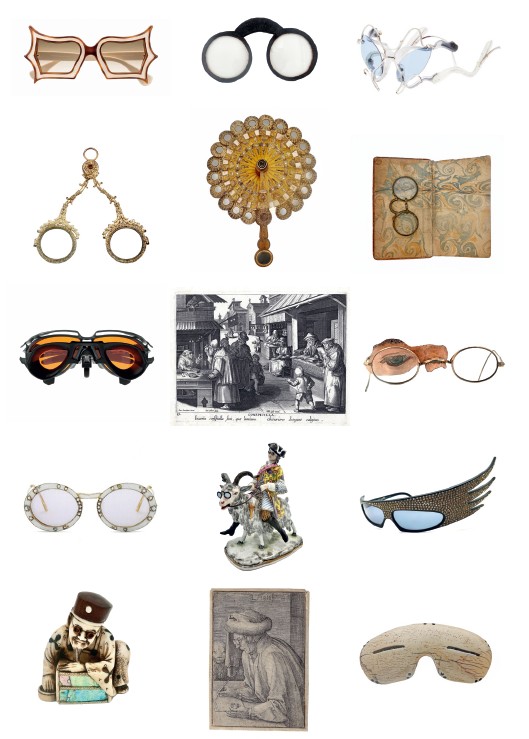
Nearly four hundred pieces and documents, from private Belgian and international collections, major museum institutions, and prestigious eyewear houses, make up a journey spanning over seven centuries. Spectacles, lorgnettes, monocles, and hand-held lorgnettes rub shoulders with 18th-century ceremonial glasses, Chinese frames with rock crystal lenses, night-driving or shooting glasses, and, more unexpectedly, glasses for dogs and cats. A few celebrity glasses also remind us how much a frame can become a true signature.
High-end eyewear and its techniques occupy an essential place in the exhibition. Alain Mikli, theo, Thierry Lasry, Cutler and Gross, Hoffmann Natural Eyewear, Meyrowitz, Lafont, Kuboraum, Bidules, Clara Besnard, Clarissa Oliverio, or Emmanuel Andrivet are among the houses, artisans, and creators associated with the project. All, through very different approaches, bear witness to the excellence and vitality of contemporary eyewear creation. Horn, acetate, wood, or metal work, precision of gesture, digital design, 3D printing, but also the reuse of components from old, sometimes forgotten stocks: eyewear today feeds as much on transmitted know-how as on new ways of inventing.
Engravings, manuscripts, paintings, and porcelain simultaneously integrate glasses into the history of images and representations. Contemporary works prolong this perspective, while optical instruments and recent technologies show how much this object continues to transform. This attention paid to gestures, materials, and their transmission naturally aligns with the missions of the Centre Albert Marinus in the field of intangible cultural heritage, for which it has been recognized by UNESCO since 2016.
A major scientific publication accompanies the exhibition and delves into its multiple facets.
Upcoming dates
Venue
Albert Marinus Centre
Rue de la Charrette, 40, 1200 Brussels
1 upcoming event here on shou · Exhibition
Nearby this week
8- Mon2NovCHROMARTIST non-profit organization
- Mon2NovExhibition: Queer Resistance
- Tue3NovFancy a Halloween safari in the Flemish Parliament?
- Tue3NovSaul Steinberg The Americans - Part 3
- Tue3NovTapta meets Judd
- Tue3NovBecome the Sky ─ Elena Ferrer, Anaïs Chabeur, Edurne Rubio
- Wed4NovEdgar Sarin - 'Matthäus-Passion'
- Fri6NovLow-stimulus morning